

Grey Vita Research Guide
Getting Started
A research guide designed to help visitors understand Grey Vita’s educational library, testing standards, product categories, and research-only peptide products.
New to the research peptide world? Below is a walk-through of the basics of research peptides and improving health, body composition, and qualtiy of life through quality, affordable chains of amino acids that have been used in research for years.
What is Grey Vita?
Grey Vita is a company of like-minded individuals that became passionate about helping people to change their life through research. We believe that peptide research should be safe AND focused affordable for everyone. Placing a label on a vial should not involve a thousand percent markup on the price. Our mission is to serve in the role of returning health autonomy back to the individual by making available bioproducs without the markup. This site is both an educational and product resource built around transparency, forward vision, and providing support for those bold that have become disallusioned by the systems that profit from sickness.
Who are these products intended for?
Grey Vita products are offered for "research purposes only" and are not intended for human consumption. (Most research has been conducted on animals or in petri dishes. Large pharmaceutical companies do not divert their financial resources to many human trials. One could hypothesize that investment into a therapy that could actually keep humans healthy and well would be counterproductive to a model based on profiting from sickness.)
How do purity and testing work?
Independent third-party testing helps support transparency by providing purity and identity information. All peptides are assigned a batch number. These vial samples are then sent to Janoshik for analysis. Those results or COA's (certificate of analysis) are provided with each peptide listing. We also do random independent 3rd party testing in groups to provide a second layer of safety. Anything below 97% is sent back or not sold. GreyVita does remove information on COA's to protect vendor privacy. We welcome our customers to seek out their own 3rd party testing of our products. One recommended lab is MZ Biolabs in Tucson, AZ. Any COA's shared with us from your own personal testing, we will exchange for discounts and free products.

How should I read a COA?
A COA may include identity, purity percentage, testing method, batch details, and date of analysis. A key variable is the amount of peptide after testing. This can be higher than the amount on vial label. Although usually negligible, some peptides protocols may be effected, so this should be taken into account.
What peptide categories are available?
Peptide categories can be organized by research interest, such as metabolic research, recovery research, cosmetic research, and cellular wellness research.
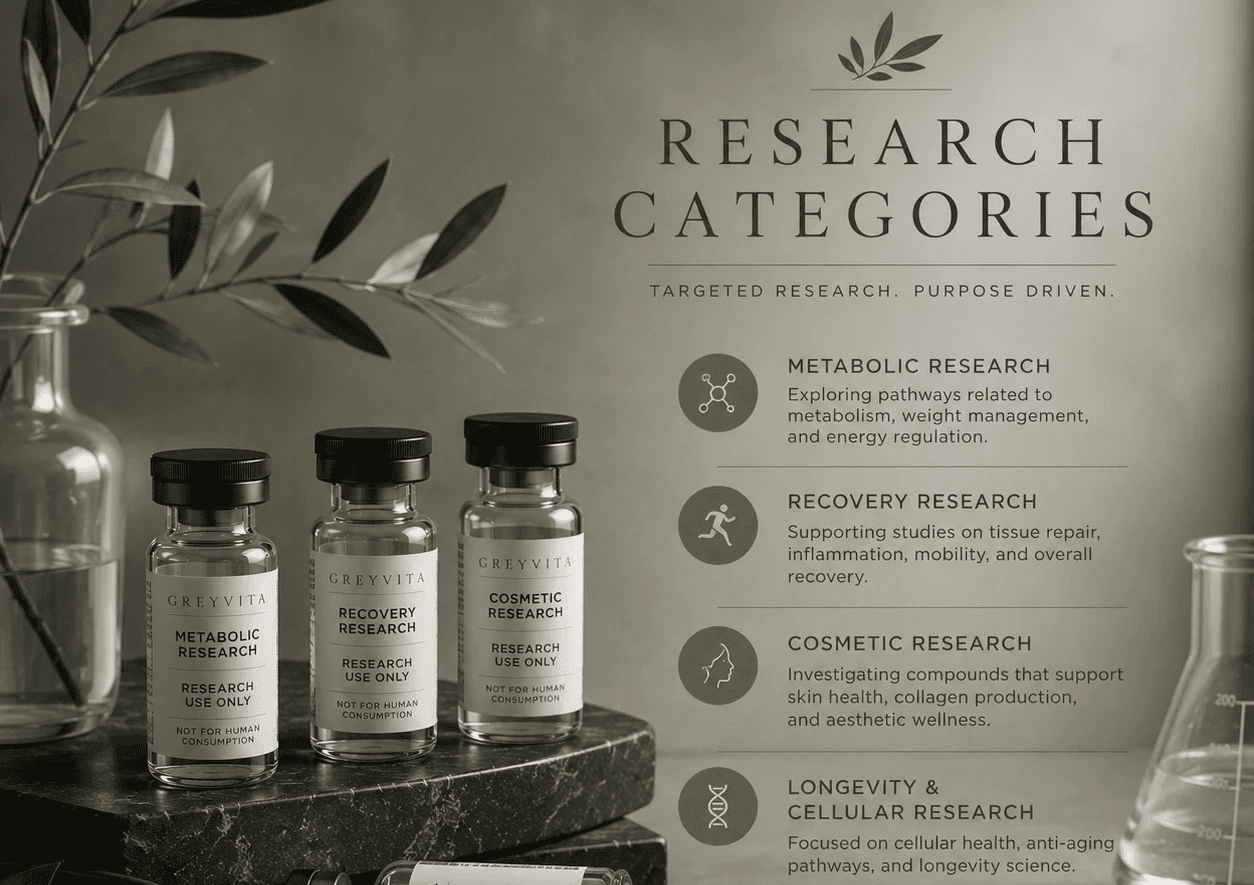
Metabolic Research
Compounds studied in relation to metabolic signaling, energy balance, and body composition research.
Recovery Research
Compounds explored in relation to tissue, mobility, inflammation, and repair-related pathways.
Cosmetic Research
Compounds commonly discussed in skin, hair, collagen, and aesthetic research contexts.
Longevity & Cellular Research
Compounds studied for mitochondrial, cellular, oxidative stress, and age-related pathways.
Cognition, Neural Health Research
Compounds studied for neurological healing, repair, regenesis and nootropic effects.
How do I choose a research compound?
Start with the research library, compare categories, review testing information, and read each product page carefully.
What is reconstitution?
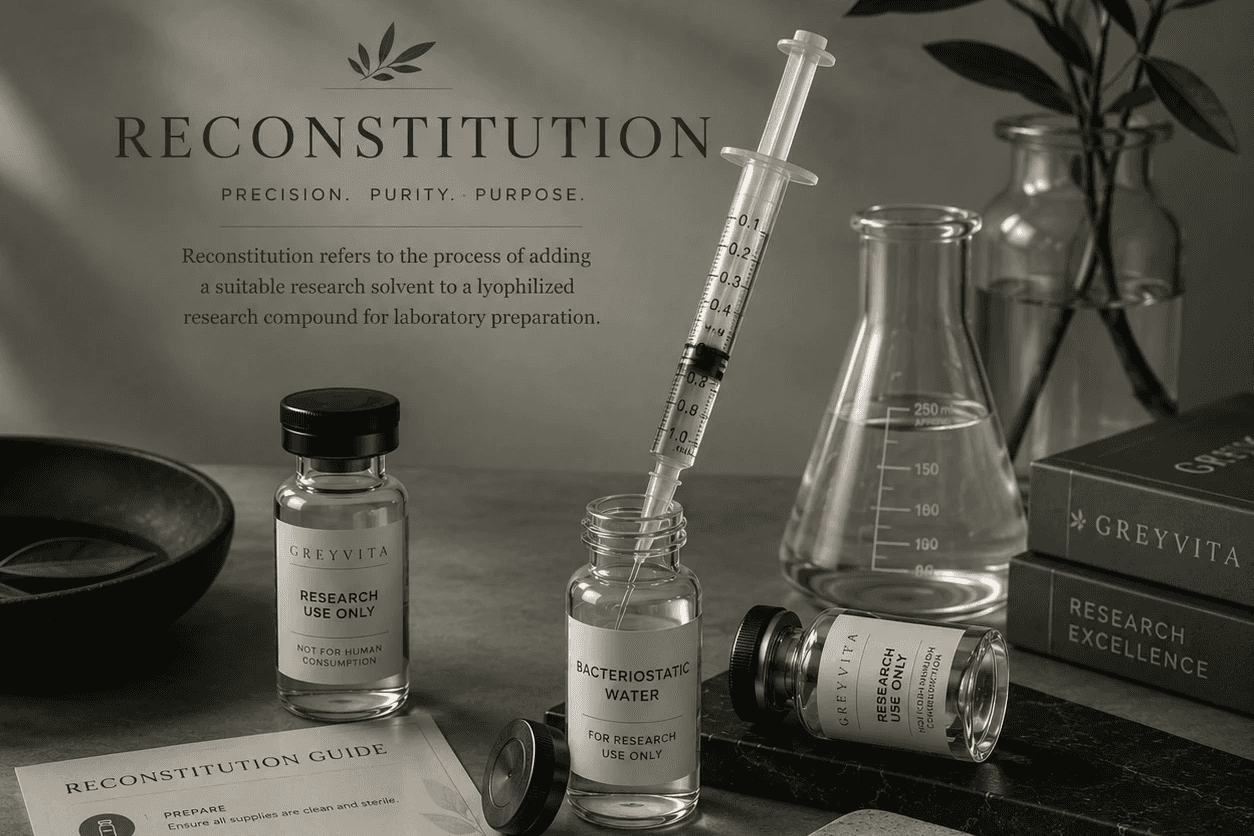
Reconstitution refers to the process of adding a suitable research solvent to a lyophilized research compound for laboratory preparation.
How should products be stored?
Storage needs vary by compound. Always review the product page and keep materials organized, labeled, and protected from unnecessary heat or light.
How does shipping work?
Orders are packed with care and shipped according to the current fulfillment process listed on the website.
Where can I learn more?
The Grey Vita research library and infographic pages are designed to provide simplified educational overviews of many of the peptides that we carry.
What should I know before ordering?
Review the product details, testing information, research-only language, checkout requirements, and terms before placing an order.
Quick Reference
Glossary
Lyophilized
Freeze-dried material, often appearing as a powder or puck inside a vial.
COA
Certificate of Analysis. A document showing testing information for a specific batch.
Purity
A measurement related to how much of the tested material matches the target compound.
Research Use Only
A compliance statement indicating that the product is not intended for human consumption.